
In September 2025, several members and clergy of Church of the Redeemer attended the New Wineskins Anglican Global Mission Conference in Black Mountain, NC. Michael Ellison, our Community and Pastoral Care Fellow and member of our current class of the Greensboro Fellows, shares about his experience attending this global event for missions.
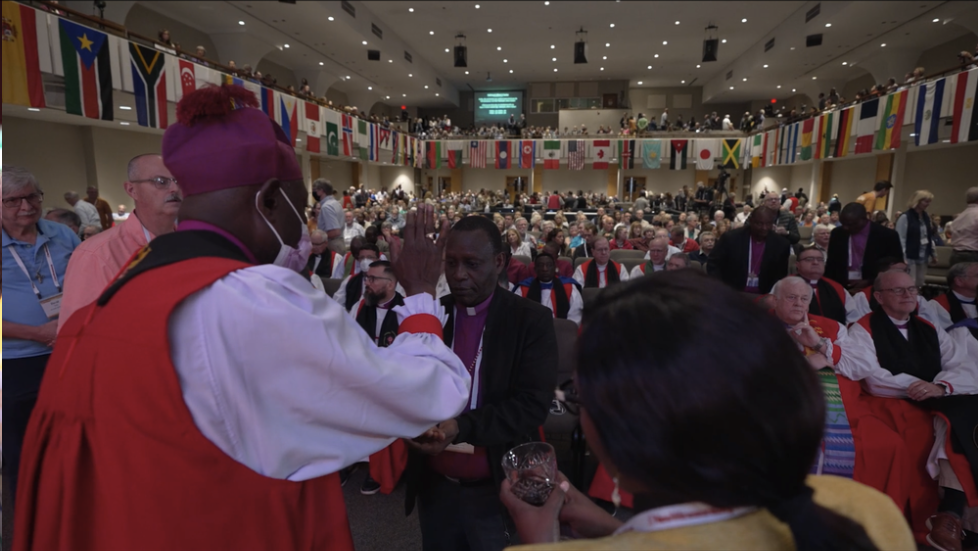
The New Wineskins Anglican Global Mission Conference in September 2025.
Two weeks after I moved from Northern Virginia to Greensboro, North Carolina—and only three days after I had joined the staff of Church of the Redeemer—I found myself in a car headed to Ridgecrest Conference Center for the 2025 New Wineskins Global Missions Conference.
I spent the next six days surrounded by almost 1,500 fellow believers from nearly 70 countries. I worshipped in multiple languages, met bishops and archbishops, and reconnected with old friends. I prayed with people who were serving around the globe. The conference was a beautiful image of the worldwide body of Christ, which came alive to me in a way I had never experienced before.
By far, the most impactful part of the conference was hearing the stories that the conference speakers shared. They recounted dramatic conversions they witnessed—or even experienced themselves (just look up Bishop Yassir Eric’s testimony to get an idea). Others shared their feelings on going into unreached lands or told stories of miracles they had seen God perform. Some described hardships and persecutions that broke my heart to hear. I had never encountered people face to face who had sacrificed and suffered so much for the sake of Christ, yet there, I got to embrace them and weep with them.
Throughout the conference, I laughed, cried, cheered, and was inspired by the courage and faithfulness of the Church. I left New Wineskins with my own passion for ministry reignited and a newfound interest in global missions. Yet, missions can often become just a small part of the whole of “ministry.” Among the many things a church must do, it can be easy for missions to be relegated to the back burner, especially in churches that already have a lot of ministries they need to worry about or are in areas that seem somewhat disconnected from international missions.
If my time at New Wineskins taught me anything, it’s that this attitude is based on several misconceptions. So…why care about missions?
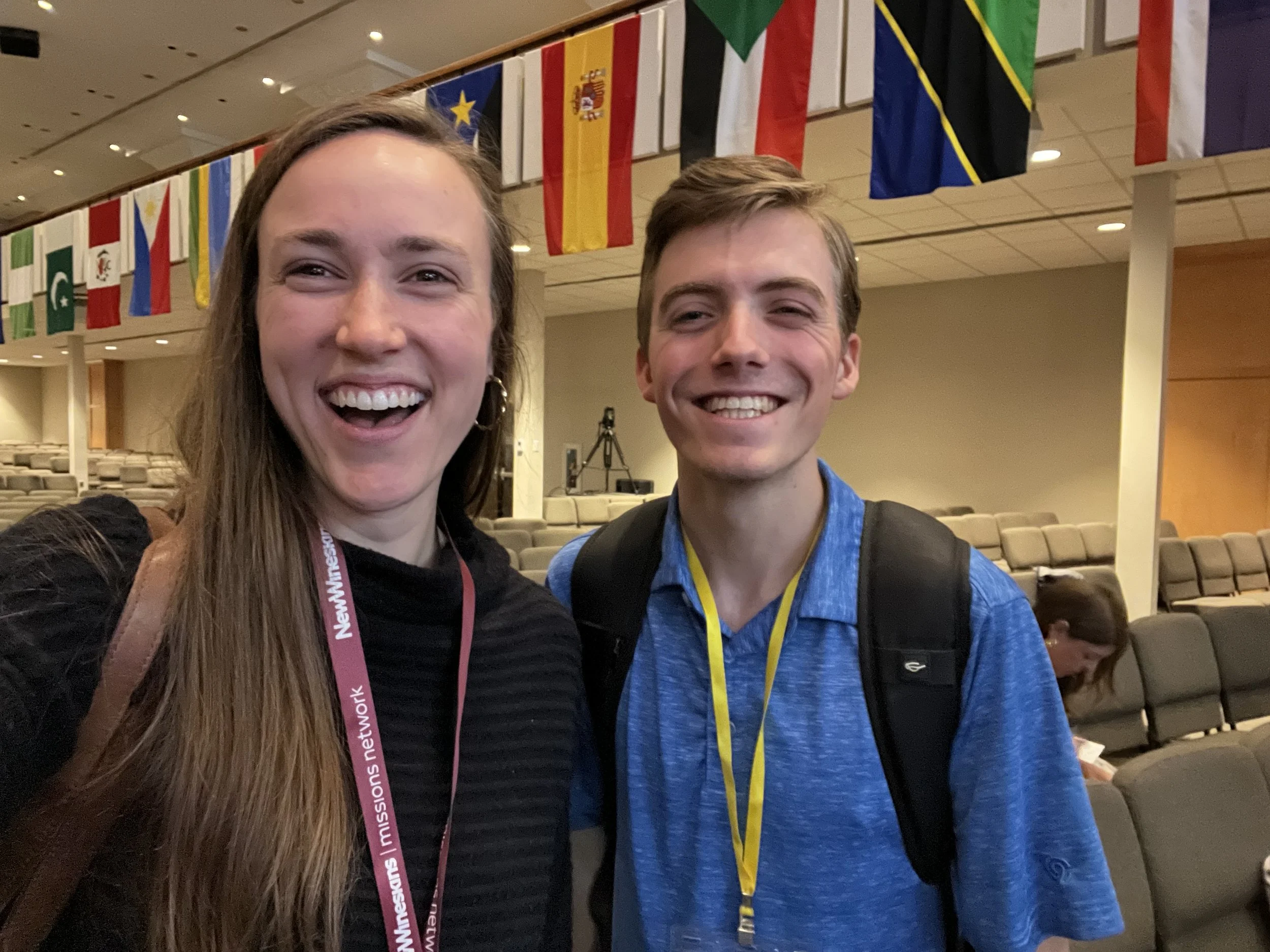
Michael with our Worship Arts Director, Amelia Blanchard at the conference.
Firstly, missions are not simply a part of ministry: they are the ministry. Jesus outlined his vision for the ministry of the Church in the Great Commission. And the Great Commission is exactly what it sounds like: a mission, a task to accomplish—to go and spread the good news! But as much as it is a mission, the Great Commission is also a command. Jesus said, “All authority in heaven and on earth has been given to me. Go therefore and make disciples...” (Matt. 28:18-19 ESV). Or again, “Go into all the world and proclaim the gospel...” (Mark 16:15). Or again, “As the Father has sent me, even so I am sending you” (John 20:21). Clearly, mission is not an optional focus within the world of ministry. It is a command from Jesus outlining his vision for his own continued work in the world.
In light of this, there is no such thing as a Christian who is not called to missions. But it is important to remember that while all are called to go on mission, not all may be called to go abroad. After all, if everything the Church does is mission, then this means that all the work of the people of God, whether done at home, abroad, in the public sector, or in our own backyard, is missional. New Wineskins showcased how the arts, for example, are missional work, a way of being “missionaries of God’s beauty” to people around us. International missions are a vital part of the Church’s mission, and there is still much work to be done there, but international missionaries are not the only people who are on mission. We all are. Wherever you find yourself is your mission field.
Jesus told his followers that they would be his witnesses “in Jerusalem and in all Judea and Samaria, and to the end of the earth” (Acts 1:8). At the conference, one of the bishops noted that Jesus tells the disciples to start the mission in Jerusalem, right where they were living. The mission began in the disciples’ own backyard, and the mission there remained as equally important as the one “to the ends of the earth.” After all, Jesus didn’t tell his disciples to move on and go abroad once Jerusalem had been preached to. Instead, many of Jesus’ followers stayed in Jerusalem all their lives, faithfully on mission to the people right around them. Most notably, Jesus’ own brother James led the church in Jerusalem from Pentecost until his martyrdom some 30 years later.
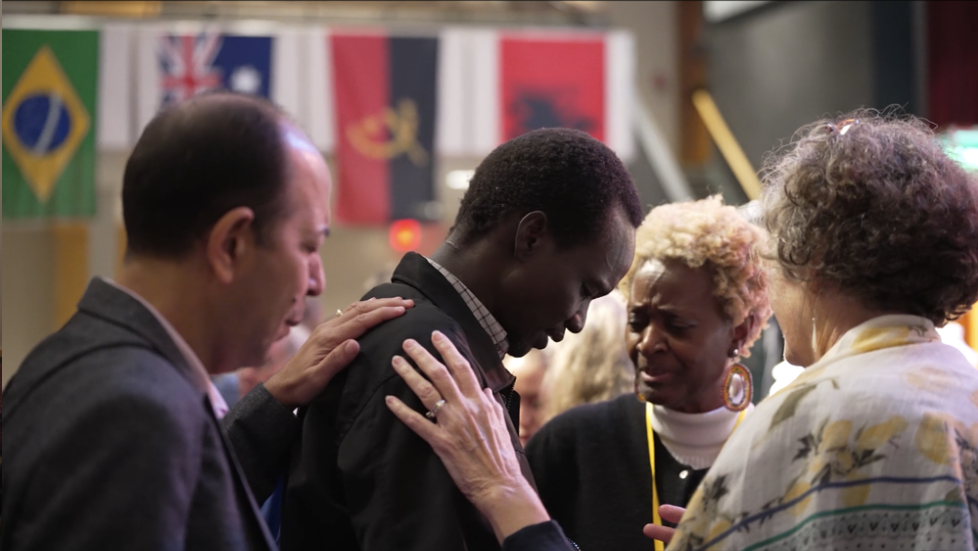
We need people in Jerusalem as much as the ends of the earth. And they need each other, too. As later chapters in the book of Acts show, the “home church” in Jerusalem became a safe place for international missionariesto return to, a place of prayerful support, and a launching pad for new international missionaries. In return, the missionaries sent from there became a source of encouragement to the community in Jerusalem, providing it with news and stories of God’s work abroad. And just as Jerusalem supported the missionaries, the missionaries supported Jerusalem. Paul frequently took up collections for the Jerusalem church wherever he went.
In many ways, Church of the Redeemer reminds me of the ancient Jerusalem church. We are invested in our local community as witness of faith in the city, teaching and nurturing the children and youth, providing for the poor, and welcoming those who might otherwise be on the margins through the Farm. But like the Jerusalem church, we also have an international reach by our sending and supporting international missionaries like the Weber family in Rwanda (Friends of Gahini), helping refugees through the Wilberforce Center, and being the headquarters of New Wineskins itself for a time. It is not an exaggeration to say that Redeemer has impacted lives around the world. But there is still much work to be done.
So, how can we as a church continue to support the work of missions at home and abroad?
We can go. We can go to our homes, into our city, and into our workplaces. We can even go abroad. Commit to fearlessly being wherever God has put you and doing the work He has given you to do. When done for Christ, with Christ, and like Christ, that work is mission.
We can support one another. This certainly means supporting our international missionaries financially, but we can also support each other as a body through encouragement, generosity, and radical hospitality.
We can send. We can be a place of support and safety for international missionaries but also a launch pad for new ones by teaching about international missions and encouraging people to think about their role in them.
Lastly, we can pray. As Jenny Noyes, the director of New Wineskins, said, “Even if you think you can’t do anything else, you can always pray.” I learned so much about the power of prayer at New Wineskins, especially praying with authority. So, let us pray for those who have not heard the gospel, for international missionaries, for the persecuted church. Let us pray for our city and for each other. And most of all, since “the harvest is plentiful, but the laborers are few,” let us “pray earnestly to the Lord of the harvest to send out laborers into his harvest” (Matthew 9:37-38).
